

How Curious Ways Solved Form Deliverability with Formspree
We spoke with David Flindall, founder of Curious Ways, about how Formspree became his go-to solution for headless builds and reliable form delivery across client projects.
David Flindall
Founder, curious ways
A Decade of Building Websites
After ten years in web design and development, you learn what works and what doesn’t. David Flindall, founder of Curious Ways, runs a web development business that has evolved significantly over the years—from a full-service agency to a focused development shop that builds and maintains websites for a steady roster of clients.
“We used to be a full agency, but we’ve axed the design side and now do strictly dev,” he explains. “We have maintenance plans with a bunch of clients, and we’re constantly building new sites while keeping existing ones running smoothly.”
In today’s challenging market for agencies, having reliable, efficient tools isn’t just about convenience—it’s about staying competitive and delivering quality work without getting bogged down in technical headaches.
The WordPress Form Deliverability Problem
For years, WordPress was the primary platform. It’s what clients knew, and with plugins like Gravity Forms and WSForms, it seemed to handle forms well enough. But there was a persistent issue that David encountered: deliverability.
WordPress is pretty terrible at delivering form submissions,” he says. “The PHP default mail function doesn’t work well. You need to hook up something like Mailgun or WP SMTP just to ensure emails actually get delivered.
It’s one of those technical challenges that requires extra configuration—not a dealbreaker, but an additional step that adds complexity to every WordPress project with forms.
The Headless Revolution
As the web development world shifted toward headless architectures and modern frameworks like Next.js, David needed a different approach to forms. Without a CMS handling the backend, the old WordPress plugins weren’t an option.
“When headless started becoming popular, we found Formspree,” he recalls. “We discovered it through the Gatsby community—it was one of those tools that kept coming up in conversations about building headless sites.”
The timing was good. As he moved more projects to modern stacks—Next.js deployed on Vercel, sites using Statamic and Dato—he needed a form solution that could work across all of them.
Why Formspree Won
The decision to use Formspree came down to a few key factors, starting with economics. “The price was good. We liked that,” he notes simply. But it was more than just cost. For someone who had spent years configuring WordPress form plugins and SMTP settings, Formspree offered something simpler: forms that just worked.
It’s very quick and easy to setup. It always works, and deliverability is always there.
Simple Implementations, Powerful Results
Unlike some agencies that build complex, custom form workflows, his approach with Formspree is deliberately straightforward. “We use Formspree for very simple stuff—newsletter forms and contact forms. If a client isn’t using a CMS and we’re building something in Next.js or another framework, Formspree is our go-to.”
The use cases are classic but essential:
- Contact forms that send notification emails to clients
- Newsletter signup forms that connect to Mailchimp
- HubSpot integrations for clients using that CRM
“We’re not doing anything fancy,” he admits. “Just simple implementations. But that’s exactly what most projects need.”
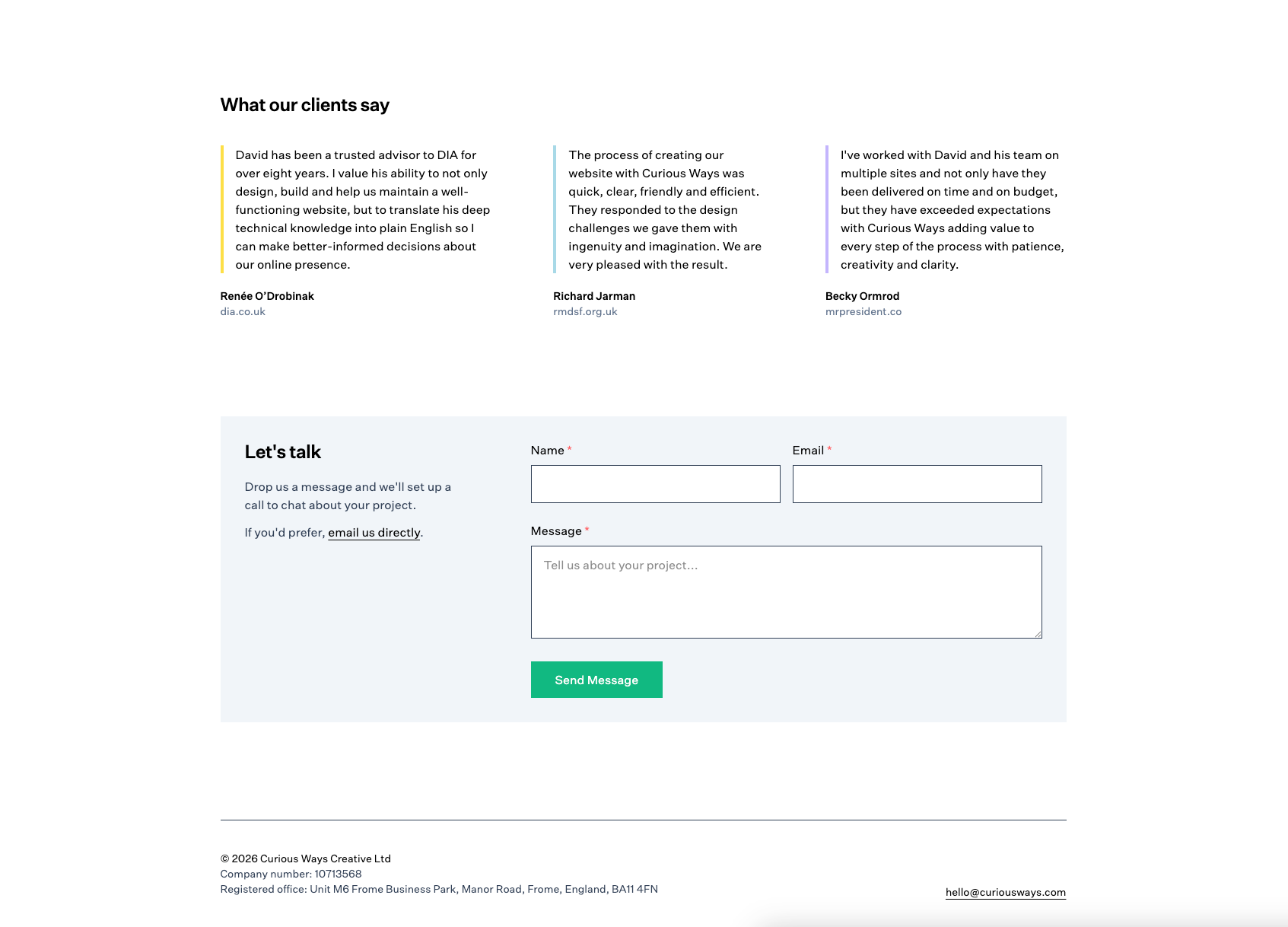 Curious Ways' Contact Form is powered by Formspree
The Maintenance Reality
Managing multiple client sites means regular check-ins to ensure everything stays functional. “I log in every couple of weeks to check spam or ensure connections to plugins are still working,” he explains.
This light-touch maintenance is exactly what a busy developer needs. The system runs reliably enough that it doesn’t require constant attention, but the dashboard provides easy access when he needs to verify something or export data for a client.
Exporting data is nice when clients need it,” he notes. “Some clients want to pull their form submissions into their own systems, and being able to export that data cleanly is helpful.
The Developer’s Perspective
David’s recommendation to other developers is straightforward and born from real experience: “It always works. Deliverability is always there. You can set it up quickly and get it looking nice without wrestling with SMTP configurations.”
For developers who have experienced WordPress form deliverability issues, this reliability is immediately valuable. For those building headless sites, it’s one less configuration to worry about.
If you’re building sites—whether it’s WordPress with headless front-ends, pure Next.js applications, or anything in between—Formspree just works. You set it up, and you can trust it to deliver.
What’s Next
When we talk about what’s next for Curious Ways, David strikes a note of cautious optimism. “Happy to have work right now—it’s a tough market,” he acknowledges. “But we’ve got lots of good maintenance clients, and we’re staying busy.”
Formspree continues to fit naturally into this business model. As he takes on new client projects, particularly those using modern headless architectures, having a reliable form solution that works consistently across different technology stacks removes one variable from the equation.
“Quick, easy, cost-effective, and gives us control,” he summarizes. “That’s what we need as a development shop.”
The Bottom Line
After a decade of building websites, surviving market shifts, and adapting to new technologies, David has learned that having tools that simply work becomes increasingly important. Formspree solved a real problem—form deliverability—while making it easy to implement forms across different technology stacks.
“We’ve moved away from being a full agency to focusing on what we do best: building and maintaining solid websites,” he reflects.
Having reliable tools like Formspree that we can trust across all our client projects makes that focus possible.
For a development professional managing multiple client sites, dealing with different tech stacks, and operating in a challenging market, Formspree delivers exactly what Curious Ways needs: reliability, ease of implementation, and one less thing to worry about.
David Flindall is the founder of Curious Ways, a web development agency specializing in building and maintaining websites across modern frameworks and platforms. Learn more at curiousways.com.